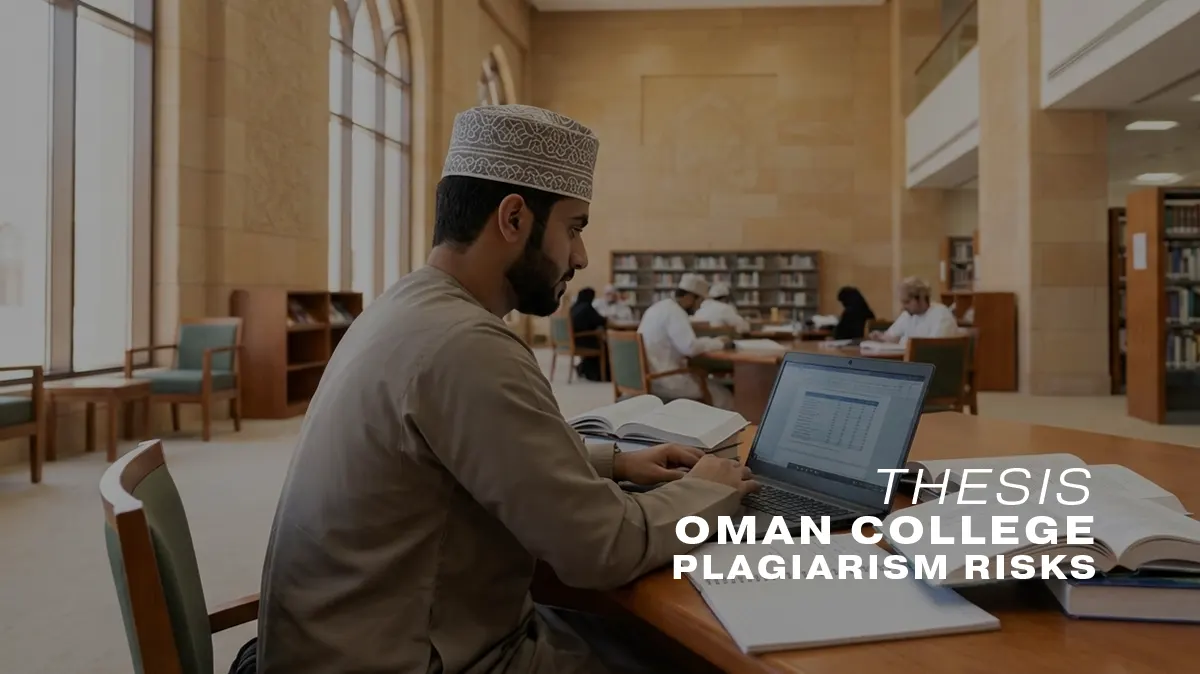

Writing a thesis at an Omani university is one of the most challenging academic milestones you’ll face. With institutions like Sultan Qaboos University and the University of Nizwa enforcing strict plagiarism policies—often requiring similarity scores below 20% on Turnitin—the pressure to avoid Oman college thesis plagiarism has never been higher. Understanding and avoiding Oman college thesis plagiarism is therefore essential for academic success.
This comprehensive guide will walk you through proven strategies to complete your Oman college thesis while completely avoiding plagiarism risks. Whether you’re at SQU in Muscat or Dhofar University in Salalah, these techniques will help you navigate academic integrity requirements with confidence.
Why Plagiarism Prevention Matters for Oman Students
Omani universities have adopted international academic standards, implementing plagiarism detection systems similar to those used in Western institutions. The consequences of Oman college thesis plagiarism extend far beyond a failed thesis—students can face disciplinary action, degree revocation, and long-term damage to their academic reputation.
At Sultan Qaboos University, which appears in global rankings such as QS 2026, Turnitin submission is mandatory for many thesis submissions. The German University of Technology in Oman (GUtech) also conducts detailed plagiarism checks that scrutinize text similarity, citation practices, and overall academic writing conventions.
The good news is that with the right approach, you can produce original work that meets these rigorous standards while showcasing your genuine research capabilities.
Understanding Plagiarism at Omani Universities
Before exploring prevention strategies, it’s essential to understand what Oman college thesis plagiarism actually includes in the Omani academic context.
Direct copying happens when you use another author’s exact words without quotation marks and proper attribution. Even a single copied sentence without credit can trigger plagiarism flags in systems like Turnitin.
Improper paraphrasing occurs when you only rearrange words or swap synonyms while keeping the original structure. Many students mistakenly think this is enough, but universities still treat it as plagiarism if it is too close to the source.
Missing citations involve using someone else’s ideas, data, or arguments without acknowledging the source. In academic writing, anything you learned from a specific source during your research usually needs a citation.
Self-plagiarism refers to reusing your own previously submitted work without disclosure or permission. If you build on earlier assignments or publications, you should clearly indicate this and obtain your supervisor’s approval.
Universities across Oman—from Sohar University to Dhofar University—apply these principles consistently, so understanding them is your first line of defense against Oman college thesis plagiarism.
Citation Mastery: Your First Defense Against Oman College Thesis Plagiarism
Proper citation is the foundation of academic integrity and a key tool for avoiding Oman college thesis plagiarism.
Most Omani universities prefer citation styles such as APA or MLA, though some programs use Chicago or Harvard formats. Always confirm your department’s required style before you begin writing.
Start your reference system early. From the first day of your research, maintain a detailed bibliography using tools like Zotero, Mendeley, or EndNote, which can automatically format citations and generate reference lists.
Cite everything that isn’t your original idea. This includes statistics, theoretical frameworks, research findings, and definitions that you encounter in your literature review, except for widely accepted common knowledge such as basic geographic facts.
Master in-text citations according to your chosen style. For example, APA style uses author–date formats like “(Al-Rashdi, 2023),” with full details in your reference list at the end of your thesis.
Use direct quotes sparingly, reserving them for definitions, key statements, or wording that would lose meaning if paraphrased. Always include quotation marks and page numbers where required.
The Art of Effective Paraphrasing in Oman College Theses
Paraphrasing is not just about avoiding detection; it shows that you truly understand your sources and helps prevent Oman college thesis plagiarism.
The read–cover–write method works well. Read the source until you understand the idea, cover it, then write the concept in your own words from memory before checking for accuracy.
Change more than just words. Effective paraphrasing restructures sentences, uses different grammar patterns, and embeds ideas into your own argument rather than copying the original flow.
Synthesize multiple sources instead of paraphrasing one paragraph at a time. Read several authors on the same topic, then write a combined summary in your voice; this naturally produces more original content.
Always add your analysis. After paraphrasing, include your interpretation, critique, or application to your thesis question so your voice remains dominant in the discussion.
Strategic Research Process for Original Thesis Development
Your research strategy has a major impact on whether you avoid Oman college thesis plagiarism.
Topic Selection and Narrowing
Choose a specific, manageable research question instead of a broad subject. For example, instead of “Healthcare in Oman,” focus on “The impact of telehealth initiatives on rural healthcare access in Al Dhahirah Governorate, 2020–2024.”
Review your university’s thesis guidelines early. Sultan Qaboos University and other institutions publish detailed formatting, methodology, and ethical requirements that you should follow from the start.
Deep, Diverse Reading
Commit to reading at least 20–30 high-quality sources for a master’s thesis, and more for doctoral work. Include recent journal articles, theses, books, and reliable reports to build a strong foundation.
Diverse reading reduces the chance that your writing mirrors a single author too closely, which helps you avoid unintentional Oman college thesis plagiarism.
Active Note-Taking
Avoid copying full sentences into your notes except for clearly marked potential quotations. Summarize ideas in bullet points using your own words and record page numbers and full citation details.
Keep a separate document for your personal reflections, questions, and ideas. These original thoughts will become the core of your analysis chapters later.
Develop Your Unique Argument
After your literature review, step back and ask what unique contribution your thesis will make. This might involve fieldwork in a specific Omani region, a new application of an existing theory, or regional comparison with other Gulf states.
Clarifying your contribution early keeps your focus on original work and reduces the risk of overreliance on sources, which can lead to Oman college thesis plagiarism.
Step-by-Step Thesis Writing Without Plagiarism
Breaking the writing process into stages makes it easier to maintain originality and avoid Oman college thesis plagiarism.
Phase 1: Planning and Outlining
Create a detailed chapter outline showing how your main argument develops. For each section, list the key sources you will reference and what original analysis you will add.
Discuss your outline with your supervisor. Universities such as the University of Nizwa and GUtech often emphasize regular supervisor meetings to support original, ethical research.
Phase 2: First Draft – Focus on Content
Write your first draft with emphasis on ideas and logical flow rather than perfection. Maintain your own voice and use placeholder citations if needed so you can fill in details later.
Set a similarity score goal. Many Omani universities accept around 15–20% similarity on Turnitin when properly cited references and common phrases are included, so aiming for 10–15% gives you a safety margin.
If you conduct primary research, consider drafting your methodology and results chapters first because they contain your most original content.
Phase 3: Citation Integration and Paraphrasing Review
During revision, verify that every external idea, statistic, or argument has a correct in-text citation and corresponding reference entry. Inconsistent or missing citations raise suspicion in plagiarism checks.
Revisit paragraphs with heavy paraphrasing. If they still resemble the original text, rewrite them using the read–cover–write method to reduce Oman college thesis plagiarism risk.
Phase 4: Plagiarism Checking
Before submitting to your university’s Turnitin system, run your thesis through trusted plagiarism tools such as Grammarly’s plagiarism detector or free checkers like PapersOwl for a preliminary scan.
When you receive a Turnitin report, examine each highlighted passage carefully. Identify whether it is a properly cited quote, common phrase, or a segment that needs rewriting.
Pay special attention to your abstract and introduction, which often contain dense references to previous research and can show higher similarity if not carefully paraphrased and cited.
Phase 5: Professional Review and Final Polish
If possible, work with an academic editor familiar with Omani university standards. They can help improve clarity, citation consistency, and adherence to formatting requirements without compromising academic integrity.
Ask peers or colleagues to read your thesis. Fresh readers may catch unclear paraphrasing or sections where your voice becomes overshadowed by source material.
Submit your final draft to your supervisor for approval before the official Turnitin submission to ensure everything aligns with departmental expectations.
Tools and Resources for Plagiarism Prevention
Using the right tools makes it easier to avoid Oman college thesis plagiarism and maintain high academic standards.
Citation management tools such as Zotero, Mendeley, and EndNote help you store references, insert citations, and automatically generate reference lists in the required style.
Plagiarism checking tools include Grammarly Premium, Turnitin (accessed via your university), and free checkers like PapersOwl for initial scans.
Writing and readability tools like Hemingway Editor and Grammarly support clearer writing, which in turn improves paraphrasing quality and reduces accidental copying.
Research organization tools such as Notion or Evernote can help you organize literature, notes, and ideas across devices, keeping your process structured.
Use AI tools cautiously. Many institutions in Oman consider submitting AI-generated content as academic misconduct, so these tools should only assist with grammar or structure—not produce thesis content.
Common Plagiarism Mistakes Oman Students Make
Recognizing common mistakes will help you avoid Oman college thesis plagiarism.
Patchwriting is when students stitch together paraphrased sentences from multiple sources without true synthesis. Instead, summarize complete ideas in your own words and add your commentary.
Inadequate citation of Arabic sources is another issue. Even if you use Arabic-language research, you must cite it correctly and provide translated titles in brackets if required by your style guide.
Reusing assignments from earlier courses without permission can count as self-plagiarism. Always ask your supervisor before building on previous work and clearly indicate where older material is reused.
Last-minute writing increases the temptation to copy. Starting your thesis early—often 6–12 months before the deadline—gives you time to research, write, and revise properly.
Misunderstanding common knowledge can also cause problems. In specialized areas like energy economics or water management in Oman, you should cite technical information even if it seems basic within your field.
What to Do If Your Similarity Score Is Too High
If your initial Turnitin report shows a similarity score higher than your university’s limit, you can still fix it and avoid Oman college thesis plagiarism issues.
First, analyze the report carefully, focusing on highlighted passages rather than the percentage alone. Many matches may come from your reference list or properly quoted material.
Exclude your bibliography when assessing similarity, as most universities do not count reference sections toward similarity thresholds.
Rewrite problematic paraphrases by altering the structure, vocabulary, and how the information is integrated into your argument. Adding examples or explanations in your own words can help.
Consult your supervisor before resubmitting, and ask for clarification on what your program considers acceptable similarity.
Support Services at Top Oman Universities
Several Omani universities offer direct support to help students avoid Oman college thesis plagiarism.
Sultan Qaboos University provides writing workshops, academic advising, and detailed thesis guides tailored to different colleges.
The University of Nizwa offers research and citation support through its library services and academic departments.
The German University of Technology in Oman (GUtech) operates a writing or learning center that supports thesis drafting, citation practices, and plagiarism prevention.
Dhofar University runs regular academic integrity seminars and provides documentation on student academic honesty policies.
Getting Professional Thesis Support
While your thesis must be your own work, ethical support can still help you reduce the risk of Oman college thesis plagiarism.
Academic editors can review formatting, citation consistency, and clarity without changing your core ideas or writing the thesis for you.
ZU Academia offers guidance on editing, structuring, and plagiarism prevention tailored to requirements at Omani universities such as SQU, GUtech, University of Nizwa, and Dhofar University, while respecting academic integrity standards.
Final Thoughts: Your Path to Plagiarism-Free Thesis Success
Completing a plagiarism-free thesis at an Omani university requires planning, discipline, and a strong understanding of academic writing conventions. By applying the strategies in this guide—careful citation, effective paraphrasing, structured research, and thorough revision—you can confidently avoid Oman college thesis plagiarism and produce original work you are proud of.
The goal is not only to pass plagiarism checks but to develop as an independent researcher who contributes new knowledge within the Omani and global academic community.
Conclusion
Completing a thesis at an Omani university can feel overwhelming, but avoiding Oman college thesis plagiarism is entirely achievable with the right strategy. By planning early, paraphrasing effectively, citing every source correctly, and using plagiarism checkers wisely, you protect both your grades and your academic reputation.
Remember that the real goal is not just passing a Turnitin check but proving you can produce original research that adds value to Oman and your field. If you want expert guidance on structuring, editing, and refining your thesis while staying fully compliant with Omani university rules, ZU Academia has been helping students ethically handle Oman college thesis plagiarism challenges for the last 5 years and is ready to support your next step.
FAQ: Oman College Thesis Plagiarism
What is Oman college thesis plagiarism?
Oman college thesis plagiarism is when a student uses someone else’s words, ideas, or data in a thesis without proper citation, including copying, close paraphrasing, or reusing their own previous work without permission.
How can I avoid plagiarism in my Oman college thesis?
You can avoid Oman college thesis plagiarism by taking notes in your own words, paraphrasing effectively, citing every source in the required style (APA, MLA, Harvard, or Chicago), and checking your thesis with a plagiarism checker like Turnitin before submission.
Do Oman universities use Turnitin for thesis checking?
Yes, most major Oman universities, such as Sultan Qaboos University, University of Nizwa, Dhofar University, and GUtech, use Turnitin or similar systems to check Oman college thesis plagiarism and enforce academic integrity policies.
What similarity percentage is acceptable for a thesis in Oman?
Acceptable similarity percentages for Oman college thesis plagiarism reports vary by university, but many institutions set a maximum Turnitin similarity threshold around 15–20% for theses, with stricter scrutiny on copied paragraphs and uncited material.
Can I reuse parts of my old assignments in my Oman college thesis?
Reusing your own previous assignments or projects without citation can be considered self-plagiarism in Oman college thesis plagiarism policies, so you should always ask your supervisor and cite earlier work clearly if you include it.
How can ZU Academia help me with an Oman college thesis without plagiarism?
ZU Academia helps students plan, write, edit, and format their Oman college thesis in a plagiarism-safe way by focusing on proper paraphrasing, citation, and originality that meets Omani university standards. For the last 5 years, ZU Academia has supported Oman students from universities like Sultan Qaboos University, GUtech, University of Nizwa, and Dhofar University to reduce Oman college thesis plagiarism risks and pass Turnitin checks ethically.
How can I contact ZU Academia for Oman thesis help?
If you need personalized support to avoid Oman college thesis plagiarism, you can contact ZU Academia through their website contact form, WhatsApp, or email listed on their service pages to get one-on-one guidance, editing, and thesis consultation aligned with Omani university requirements.

Leave a Comment